
Things to Do in Kyoto, Grouped by How You Actually Move

What we would book or buy
Booking partner
Klook
activities
Booking partner
KKday
activities
Kyoto has a list problem. Everyone arrives with the same fifteen names, tries to see them in the order they appear in a guide, and spends the trip on buses crossing the city to reach places that were twenty minutes apart if only they had been grouped.
The city is arranged in bands. The eastern hills hold one dense run of temples and lanes. The west holds Arashiyama and its bamboo. The centre holds the market, the castle and the grid. The south holds one enormous shrine. Each band is a half-day or a day, and almost nothing is worth crossing the city for twice.
What follows is that structure, plus the small number of things worth paying for, and the ones people regret.
Two rules carry most of the saving. Group by area, not by fame: if two places sit on opposite sides of the city, they belong on different days even when a list puts them next to each other. And start early, because the eastern lanes and the bamboo grove both move from pleasant to shoulder-to-shoulder within an hour of opening — the difference between seven and nine in the morning is the difference between a photograph and a queue.
The eastern hills: the densest half-day
This is the band most people mean when they say “Kyoto”. It runs from Kiyomizu-dera down through the preserved lanes of Sannenzaka and Ninenzaka, past Yasaka Shrine into Gion, then north along the edge of the hills through Chion-in, Nanzen-ji and the Philosopher’s Path towards Ginkaku-ji.
- Kiyomizu-dera. Go first, at opening. The approach lanes are the point as much as the temple, and they are empty only before the shops open.
- Sannenzaka and Ninenzaka. Steep stone lanes between the temple and the flat city. Best walked downhill, early, before the crowds arrive.
- Gion. The old entertainment district, best in the evening when the lanterns come on and the day-trippers leave. Be explicit with yourself about the etiquette: people live and work here, and photographing geiko in the street is not a sightseeing activity.
- Nanzen-ji and the Philosopher’s Path. Quieter than the southern end, and the walk north towards Ginkaku-ji is one of the few genuinely calm stretches in the city.
Realistically this is a full day if you walk it, and it is the day to protect. If you only have one day in Kyoto, this is the one.
Arashiyama and the west
The bamboo grove is the headline and the least interesting part of the area, because it is short, crowded, and over within ten minutes. The reason to go west is the rest of it.
- Tenryu-ji and its garden, which sits next to the grove and is the better use of the same hour.
- The river and Togetsukyo bridge, where the view opens up and you can sit down.
- Okochi Sanso, a villa garden on the hillside that most people walk past, and the reason the area is worth half a day rather than an hour.
Go early, and go by train rather than bus. Arashiyama is at the end of a line, which means the crowd arrives in waves that you can get ahead of by being on the first useful service.
The order that works is grove, garden, river. Walk the bamboo while it is still quiet, go straight into Tenryu-ji while the gate queue is short, then let the rest of the morning run downhill towards the bridge and the river, where there is space to sit. Doing it backwards means you arrive at the grove at the moment everyone else does, which is the one thing worth avoiding in this part of the city.
The centre: market, castle, grid
The flat middle of the city is where Kyoto is a working city rather than a preserved one.
- Nishiki Market. A covered lane of food stalls and small shops. It is genuinely narrow, and walking it during lunch is a mistake; go when it opens or in the late afternoon.
- Nijo Castle. The shogun’s Kyoto residence, with the famous nightingale floors and a garden worth the walk.
- The imperial palace park. Free to walk, wide, and a good way to decompress between two temple-heavy days.
The centre is also where you eat. Kyoto’s food reputation is real but concentrated: the market for grazing, and the side streets around Pontocho and Kiyamachi for a proper dinner, if you book ahead.
Two practical notes for the middle of the city. The department stores above the main stations have food halls in their basements that are worth twenty minutes even if you buy nothing — they are where the city’s patisserie and prepared food culture is most visible, and they are a reasonable wet-weather substitute for the market. And the distances here are flat: Nishiki to Pontocho is a five-minute walk, which makes the centre a good evening plan after a morning that started at a temple on the other side of town.
Fushimi Inari and the south
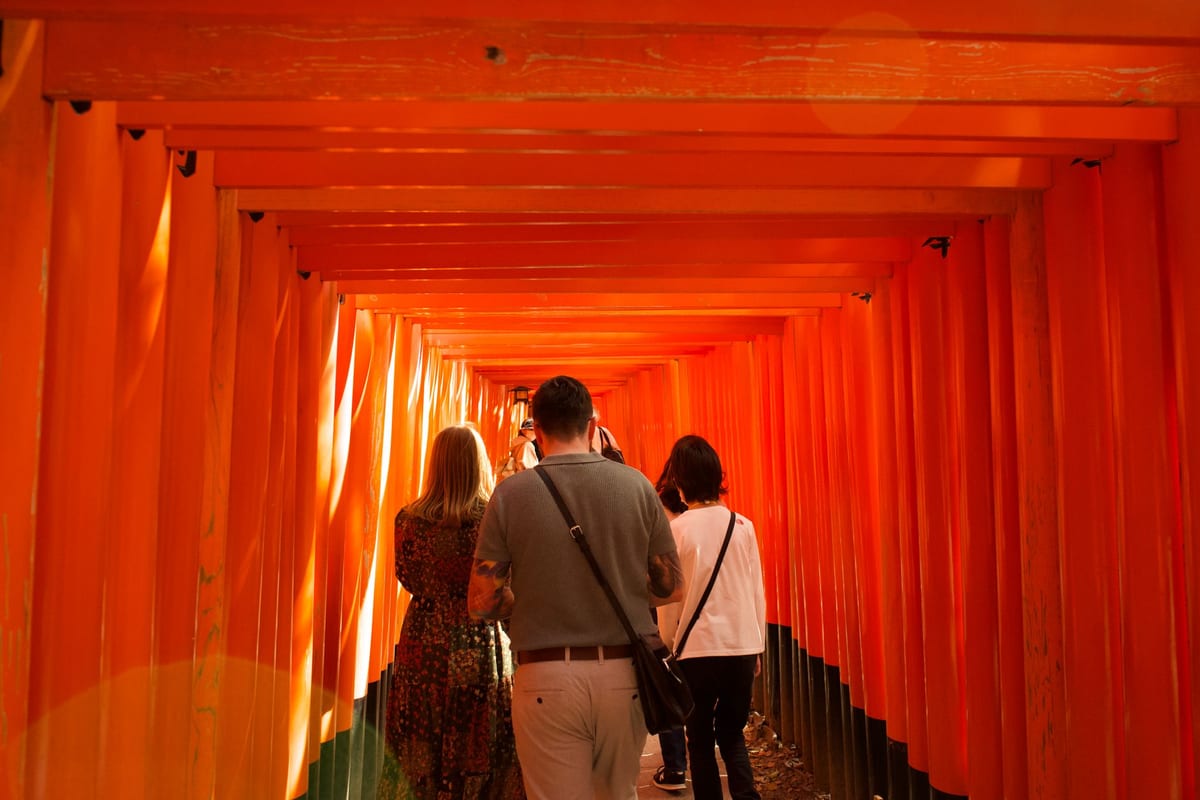
One enormous shrine, and the walk up the mountain behind it. The torii tunnels near the entrance are the postcard; the crowds thin out surprisingly fast after the first ten minutes of climbing, and almost everyone turns back too early.
Two practical notes. The full loop takes a couple of hours if you go up and over rather than doubling back, which is why the morning is better. And the shrine grounds are accessible around the clock, though the shops and stalls are not; confirm current arrangements before you plan a dawn visit.
What is worth paying for
Most of Kyoto is free to walk. The paid experiences fall into two kinds: the ones that save you time, and the ones that give you access you cannot get on your own.
Worth it, for most travellers:
- A guide for the eastern hills, on your first morning. Not for information — for orientation. One morning with someone who knows the lanes turns the rest of the trip into a walking city instead of a bus city.
- A tea ceremony, once. It is the one cultural experience in Kyoto where being a participant rather than a spectator changes what you understand.
- A cooking class, if you have a rainy day. Kyoto’s food is subtle and the technique is not obvious from eating it.
Usually not worth it:
- A bus tour that covers five temples in one day. You will see five car parks.
- Kimono rental on a hot day. The photographs are good; the afternoon is not.
- Any experience booked for a time you could not realistically reach after the previous stop.
One more thing worth saying about the guided morning: it earns its cost on day one, not day three. Booked late in a trip, it becomes a nice walk with commentary about places you have already seen badly. Booked on the first morning, it sets the geometry of everything that follows, which is the actual problem most first-time visitors have in Kyoto.
The practical point is that these are timed products with fixed slots, and the popular ones go on the dates people want. Klook and KKday both sell Kyoto experiences with dated slots; our comparison of the two platforms explains how their cancellation terms differ, which matters more than the headline price when a date might move. If the operator’s own site will not take your card, they are the usual fallback.
Two days, or three?
Two days gets you the eastern hills and Arashiyama, with the centre on the way home. That is a good trip.
Three days adds Fushimi Inari properly and gives you one day to leave the city: Nara for the deer and the temples, or Uji for tea, both of which are short train rides. If you are weighing up which city deserves that spare day, our comparison of day trips from Kyoto covers Nara, Osaka, Himeji and Kobe on travel time and what you actually get. If you are combining Kyoto with Osaka, our Osaka itinerary is built to sit alongside this one, and the two cities are close enough that a single base is a reasonable choice — our guide to choosing a Kyoto base covers which end to stay in.
Mistakes that cost a day
- Buying a bus pass and using it as a plan. The buses are slow and full; the trains and your feet are faster for most of the eastern hills.
- Doing Kiyomizu-dera at eleven. You will queue to move.
- Saving Arashiyama for the afternoon. The grove is a corridor, and by then it is a single-file procession.
- Booking three timed experiences in one day. Kyoto’s distances are deceptive; a twenty-minute walk between two temples is a forty-minute walk with stairs.
- Skipping the food. The temples close; the restaurants do not.
Frequently asked questions
How many days do you need in Kyoto?
Two full days covers the eastern hills and Arashiyama without rushing. Three lets you add Fushimi Inari properly or take a day trip to Nara. One day is enough for the eastern hills only, and it is still worth it.
What is the single best thing to do in Kyoto?
The walk through the eastern hills at opening time: Kiyomizu-dera, down through the preserved lanes, into Gion. It is free, it is the reason the city is famous, and it is only pleasant before nine.
Is the bamboo grove worth it?
The grove itself is short and crowded. The area around it — the temple garden, the river, the villa gardens on the hillside — is worth half a day. Go for Arashiyama, not for the bamboo.
Do I need to book Kyoto experiences in advance?
For a tea ceremony, a guided walk or a cooking class on a specific date, yes. Slots are limited and weekends fill first. Temple entry generally does not need booking, though some have timed arrangements; confirm before you go.
Is Kyoto walkable?
The eastern hills and the centre are, if you accept stairs. Arashiyama and Fushimi Inari are separate trips by train. Planning on foot plus trains is faster than planning on buses.
The bottom line
Kyoto is four bands, not forty attractions. Give the eastern hills a full day, Arashiyama half a day plus travel, the centre an afternoon, and Fushimi Inari a morning. Then spend the money on one guided morning and one experience you would not otherwise have, rather than on transport that moves you between car parks.
If you are booking timed experiences, compare what Klook lists and what KKday offers before your dates get close — and leave the rest of the day to the lanes, which cost nothing and are the actual reason to come.


