
Day Trips from Kyoto: Nara, Osaka, Himeji and Kobe Compared

What we would book or buy
Booking partner
Klook
activities
Booking partner
KKday
activities
Kyoto is easy to treat as a bubble. You arrive, you walk the eastern hills, you eat, and the days fill themselves. But four cities sit within roughly an hour by train, and a single spare day spent in one of them is often a better use of the trip than a fourth temple.
They are not interchangeable, though. Nara is a morning of deer and one enormous temple. Osaka is food and noise. Himeji is one building. Kobe is a harbour and a very different kind of afternoon. Picking wrong is the difference between a highlight and a train ride you regret.
Four things decide whether a day trip works, and none of them is “what is there to see”.
- Travel time, door to door. Not the headline train time — the whole thing: walk to the station, buy or validate a ticket, ride, walk out the other end. Kyoto to Osaka sounds like fifteen minutes and is closer to forty-five once you count the ends.
- What you actually do when you arrive. Himeji is one building, which is either perfect or thin depending on you. Osaka is a city where you could spend three days. Match the place to the shape of your energy that day.
- Whether it needs booking. A temple does not. A cooking class, a guided walk, a hired car for a rural day does, and those are the parts that sell out.
- Whether you are doubling up. If you have already booked a theme-park day in Osaka, a second Osaka day trip is a mistake. Spread your days so each city gets the reason you came for.
Nara: the safest bet
About forty-five minutes from central Kyoto by limited express, and the most obviously “day trip” of the four.
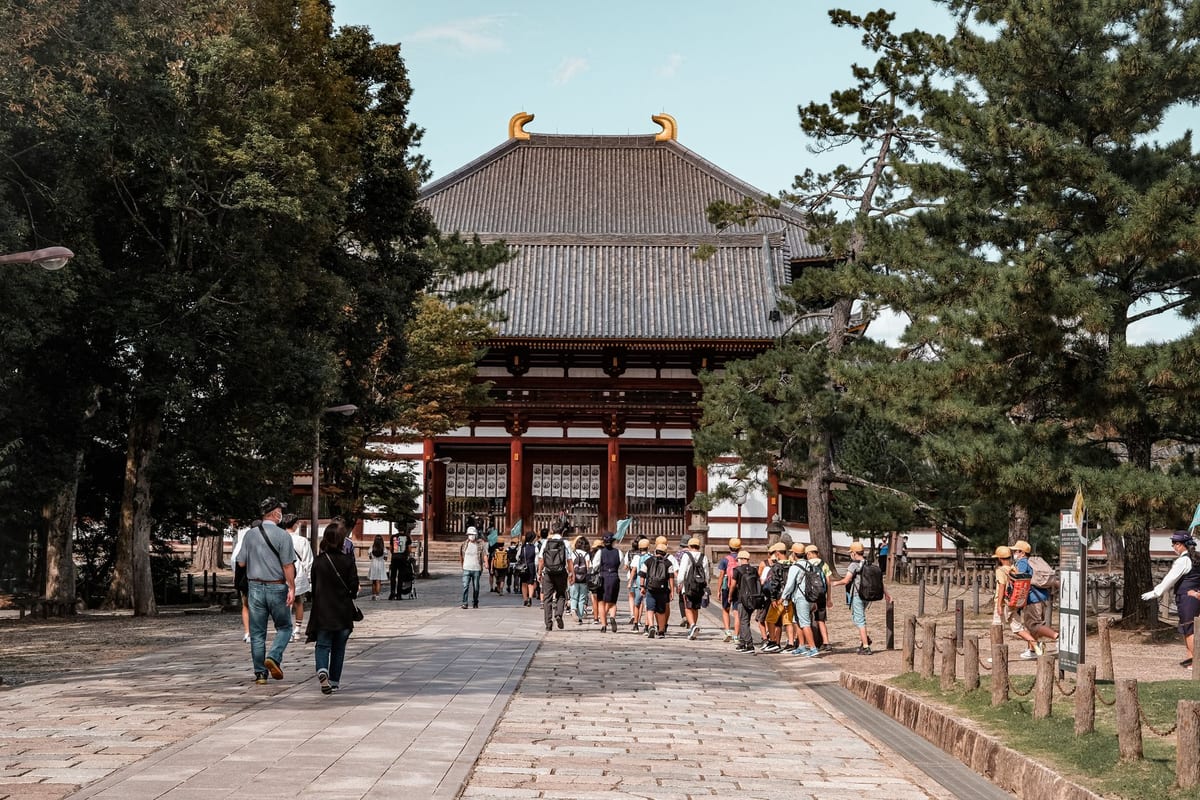
What you get is the deer park and Todai-ji, a temple hall big enough that the scale stops being abstract. Add Kasuga Taisha’s lantern-lined approach if you have the afternoon, and the old merchant district of Naramachi for lunch.
It works as a half day or a full one, which is why it suits almost everyone. Go early — the deer are calm and the temple is quiet before the tour buses — and leave the afternoon free rather than pushing on to a second site you do not care about.
The one caveat: Nara is not a city break. If you want restaurants and an evening, it is not the choice.
Osaka: the one that is not really a day trip
Thirty minutes by shinkansen, or around forty-five on the JR rapid service. The travel is trivial; the problem is that Osaka deserves a night, not an afternoon.
If you are using Kyoto as a base and only have one spare day, Osaka as a day trip means choosing between the food districts and one paid attraction, and doing neither properly. It is a better plan to give Osaka a night or two of its own — our three-day Osaka itinerary assumes you are staying there.
Where the day trip does work: you have already been to Osaka once and want a specific thing — a particular restaurant, a ball game, an exhibition. Then treat it as a targeted errand, not a city visit.
Himeji: one building, done properly
Roughly an hour by shinkansen, or about ninety minutes on the rapid service. Himeji Castle is the reason to go, and it is the one Japanese castle that rewards the trip on its own.
Two practical notes. The keep has a timed flow through steep wooden stairs, so it is not a place to rush, and the grounds are worth an hour after the interior. And the castle is a half-day, not a day — most people pair it with something else, either the nearby Engyo-ji temple or a stop in Kobe on the way back.
If you are only going for the castle and returning immediately, you will spend more time on trains than in the building. Pair it, or skip it.
Kobe: the underrated one
About thirty minutes by shinkansen, or around fifty on the rapid service. Kobe is the day trip people forget, and the one that surprises them.
What is there: a compact harbour, the Kitano district of old foreign residences on the hill, a Chinatown that is genuinely a local institution rather than a tourist trap, and the beef that made the name. It is a walking city with a slower rhythm than Osaka, which makes it a good pairing with Himeji rather than a substitute for it.
The trick is to stop early. Kobe rewards two or three stops and a long lunch, not a checklist.
Which one, by the shape of your trip
| Your situation | Go to | Why |
|---|---|---|
| One spare day, first trip to Japan | Nara | Fast, unmistakable, works as half a day if you run out of energy |
| You like castles and are happy on trains | Himeji, paired with Kobe | The castle is the best in the country; Kobe makes the return leg worthwhile |
| You want food and an evening out | Osaka, but stay the night | A day trip wastes the part of Osaka that matters |
| Travelling with children | Nara | Deer, open space, short journey, no booking needed |
| You have already done the classics | Kobe | A different city, less crowded, easy to reach |
| Raining heavily | Osaka | Indoor markets, museums, and a short ride home |
Train or tour?
Most of these are easy by train, and doing them yourself gives you the flexibility to leave when you are done. The exceptions are worth knowing:
- Nara by train is straightforward; the station is a short walk or bus from the park.
- Himeji by train is simple, but the castle’s timed entry means a tour sometimes saves the queue.
- Kobe and Osaka need no tour at all.
- Anything rural, or a food-and-market day, is usually better with a guide — the value there is the ordering and the introductions, not the transport.
If you want to book a guided version, both major Asia platforms sell these as dated products. Klook and KKday cover day tours from Kyoto to Nara, Himeji and the countryside, and our comparison of the two explains how their cancellation terms differ — which matters more than price when a day might move.
For rail, check whether a pass or a point-to-point ticket is cheaper for your route before you buy anything. The arithmetic is in our rail pass comparison, and the same logic applies here: a pass only pays if you are doing several long runs.
Timing your day
The trains are frequent enough that you do not need a timetable, but the shape of the day still decides how much you see.
Leave Kyoto between seven and eight for Nara or Himeji. Both are places where the first hour is quiet and the middle of the day is not, and an early start also gets you back before dinner. For Kobe, a later start is fine — the harbour and the Kitano hill are an afternoon, not a morning.
On the return leg, avoid the 17:00–19:00 window if you can. That is when every day-tripper and commuter in the region converges on the same trains, and standing for an hour after a full day of walking is a poor ending.
One last piece of arithmetic: a day trip costs you the day in Kyoto. If your Kyoto list is long, two spare days are better spent one day out and one day in, rather than two trips that leave the city half-seen.
What to skip
- Two day trips in two days. Kyoto itself is the reason you came; a trip that spends half its days elsewhere is a different holiday.
- Himeji castle plus Osaka in one day. Both are half-day-to-full-day places, and the trains do not line up as neatly as they look.
- A guided tour of Nara if you only want the deer. You can walk it yourself in twenty minutes.
- Osaka as a day trip when you have not seen Kyoto properly yet. The eastern hills are worth a full day and they are already here.
Frequently asked questions
What is the best day trip from Kyoto?
Nara, for most people: short journey, no booking, and it works as half a day or a full one. Himeji is the better answer if castles are your reason for travelling.
Is Osaka worth a day trip from Kyoto?
It is worth a night rather than a day. The train is short, but Osaka’s best parts — the food districts after dark — are exactly what a day trip cuts off.
Can I do Nara and Osaka in one day?
You can, and you will do neither well. Nara is a morning plus lunch; Osaka deserves the evening. Doing both means leaving Nara at two and arriving in Osaka with three hours before the shops close.
Do I need to book day trips in advance?
Only the guided versions. Temples, castles and trains can be arranged on the day, though the castle’s timed entry and any cooking class or food walk should be booked ahead in peak season.
Is the Japan Rail Pass worth it for day trips?
Only if your wider itinerary includes two or three long shinkansen runs. For Kyoto-based day trips, point-to-point tickets are usually cheaper — do the arithmetic for your route rather than buying on reputation.
The bottom line
Pick the day trip that matches your energy, not the map. Nara for a gentle, unmistakable morning; Himeji and Kobe together for a full day of castle and harbour; Osaka only if you are staying the night.
Book the guided parts early and leave the rest loose, because the best version of each of these trips ends earlier than you planned. If you are still deciding how to spend the Kyoto days themselves, our guide to what to do in Kyoto groups the sights by area, and comparison of the ticket platforms covers the booking mechanics.


